Thursday, 9 December 2010

Annual Members Photography Show
until 28th January 2011 @ Photofusion
Second Thursday night of December at Photofusion gallery was an opening night for annual members photographic show. Editor of a photography magazine HotShoe, Miranda Gavin, selected the winner of the competition. “It was a difficult decision,” she said between Odette England, the winner, Vikram Kushwah and David Gopsil.
One of the runners ups, Vikram Kushaw whom recently graduated from Rochester University presented his latest project Ofelia, with strong emphasis on uncanny feeling. He said, “it is good to see my work exhibited as it gives me faith that people like my work.” The Indian photographer Kushwah was pleased with the results, and is now preparing for an up-coming exhibition in Barcelona in the beginning of next year.
Gavin, editor in chief of HotShoe magazine, was honored when first approached and asked to select the winner. She described that “she was evaluating the process in three stages and it was not easy”. Photographers had traveled for inspiration to exotic locations such as Madagascar and also documented local London scene. The gallery co-coordinator Gavin Evans was saying she “wanted also a representation of different genres”. Adrian Wood, a part of the board of Directors added that to the main body that “the idea also was to showcase the diversity of the membership scheme”, when selecting the 14 photographers from first 100 submissions.
The winner Odette England who was not present but receives the Hotshoe Photofusion Award, an annual subscription to HotShoe magazine, a single-page feature and interview with Gavin in the February issue of the magazine.
The exhibition is showcasing Photofusion members ongoing or recent body of work until 28 January next year. The keynotes judges looked at were simplicity, texture, and concept in the diverse selection of artworks.
It is organized annually second year now within membership scheme, photography practitioners from various backgrounds. Works ranged from vivid urban city collages to snapshot style portraits taken with latest iPhone. Publics vote favorite will be announced in the end of the exhibition.

http://hotshoeblog.wordpress.com/
http://www.photofusion.org/gallery/photography/exhibitions/current/default.htm

Tuesday, 30 November 2010

Byroglyphics 'Subsidiary' @ Signal Gallery

exhibition open until 11th Dec

Evocative is the word that comes to mind when admiring artist Byroglyphics’
piece 'Departure Lounge'. Yet, what is it that makes his work so magnetic? Is it
 the subject matter, the colour palette, the brush strokes, or the concept of the 
artwork as a whole? 

Currently on show at the Signal Gallery in Hoxton, the collage-type painting is
 part of Byroglyphics’ experimental collection, ‘Subsidiary’ an exhibition which
places work like ‘Departure Lounge’ alongside contrasting pieces of art to evoke
a unique kind of thought process.

Being Byroglyphics', aka Russ Mills’ second
 solo exhibition, he is this time around using his background in illustration and
animated film making to push the boundaries even further, using the freedom of
the digital medium to its fullest.
‘Subsidiary’ establishes a good mix of drawing and collages, applied through
 various technical forms to emphasize the depth and profound darkness suggestive
 of Mills’ subject matter. Additionally, the extreme use of shaded dark acrylic
adds intensity and character to his already powerful and suggestive pieces, many
 of which depict portraits of appealing female figures that seem to emit an
immensely challenging image.


Many of Byroglyphics pieces carry with them accompanying titles which are just
as thought provoking as the works themselves. For example, listed among
antidepressants, ‘Desipramine’ and ‘Sinequan’ perhaps omit the same sense of
euphoria as Mills is trying to capture in the images these titles represent. His
strong brush strokes fulfil the artwork’s multi-dimensional potential, while the
accompanying drawing-effect forms lingering subtle emotions within each image.
The confidence and sex appeal in the subjects’ appearance emphasises this
aforementioned magnetism, especially in the portraits illustrated on Chinese
 comic pages.


‘Subsidiary’ proves why Byroglyphics is a remarkable talent in the urban art
scene, drawing in people’s attention with his personal fascination for one’s
‘inner demons’. Unusual are his artistic features which combine distinctive
looks from the animal kingdom with realistic human figures. Perhaps striking but
not surprising, the majority of his exhibited artwork this time was marked sold 
by the second day of the exhibition.

Photographs provided by Signal Gallery


Departure lounge


Tuesday, 23 November 2010

Black Rat Projects present "Small Acts of Resistance"


4th November – Tuesday 30th November 2010

Vibrant, lively, and even a little surreal are a few ways to describe the latest pieces by six worldwide artists at the Black Rat Projects' Gallery. Focusing upon the struggles within society, the exhibition's artists have 'urbanised' fine art, making each piece truly innovative. Through a diverse range of mediums, each artist encourages viewers to take a second look and uncover the varying portrayals of social resistance in each piece.

One artist, Matt Small, uses his art to reflect everyday native people in a vivid and powerful way. The size of his sculptures draws you in, but it is the way Small represents a nation in such a noble way which is most captivating. Featuring alongside Small is New York artist Swoon whose enormous installation of a disaster on mixed media adds a different dimension to the exhibition. The image of the small boy featured in Swoon's piece catches the observer's eye, and helps highlight the enormity of the disaster surrounding him.

Other artists involved in the 'Small Acts of Resistance' exhibition include Peter Kennard, whose love for photomontage speaks for a new era of social struggle. His collaborative project with Tarek Salhany focuses on an obscure layering composition based upon a newspaper surface, giving the black and white portraits a hidden emotion which as viewers we try to uncover.
Danish artist Armstock's simple yet profound drawings also depict this sense of hidden emotion and resistance. As if the artist is one step ahead of us as viewers, the rough charcoal conveys the medium while allowing an observer to try to uncover and envisage the scene more vividly. The central focus of Armstock's work is interaction; between the work and the viewer, and between tension and conflict, encapsulating the theme of social struggles.

Know Hope is an Israeli artist whose work pieces together a combination of white birds, white flags and raindrops. His focus is on producing a kind of non-linear narrative in his work to establish a connection between art and the social environment it is created within. This direct connection between art and social environment is also dealt with by DotMasters who in a sense expose humankind by using their work to confront the prominence of vandalism in society. A selection of scenes from CCTV frames illustrates the violence occurring in current society, something which shocks viewers but also acts to inspire resistance and encourage more creative talent on the street.


Photography by Black Rat Project Press Office


'@earth/civilians' by Peter Kennard with Tarek Salhany


'Feebled (With Humbled Hearts But Unable Limbs)' by Know Hope

'Saved Chewe' by Matt Small


'Haiti' by Swoon

Saturday, 20 November 2010

Vyner Street Galleries

The Vyner Street Gallery is fast becoming the place to be on the first Thursday of every month. Located in Cambridge Heath and known as London's contemporary Art District, the area is bustling with people looking to discover the next best thing in the art world. The scene, mostly attracting stylish locals and the arty crowd, is as one might expect 'happening', and most surprisingly, you don't need your name on a guest list to catch a glimpse of Vyner Street's hidden gems.
With emerging talents sitting alongside established names, a simple walk down this street will see you shifting from conceptual fine art to meaningfully arranged and composed objects. While the galleries, including Gift, Degree Art, East2Gallery, and Five Hundred Dollars all represent artists who all bring prominent, fresh and unique styles to the art market.
Hosting specialised exhibitions, Vyner Street offers a well needed collective art presence. Most recently, Lucinka Soucek, one of Vyner's outstanding talents, presented her Wood and Trees exhibition using a woodcut technique to portray varying illustrations. The roughness derived from Soucek's technique created a vividness which draws the viewer into her work, causing us to focus in on the intense detailing which evokes a sense of intimacy and warmth.
Alongside Soucek, Gift Gallery presents Elaine Wilson, whose artwork has plunged into studying female identity. The small sculptures of women in Victorian dress depict a conventional ideal which is contrasted by the way they are holding pointed guns. The emotions held within the sculptures aim to spark a curiosity in viewers in a bid to spark a consideration of femininity and female identity.
If Gift Gallery doesn't satisfy you, take a wander down to Degree Art where Alien Beauty: Alien Freedom is currently being exhibited. Created by artists Robert Dunt and Alistair Baxendale, the exhibit uses mixed media and photomontage whilst contrasting new and famous paintings, to reveal the boundlessness of imagination in artistic creativity and perception. With inspiration including pop art, Alien Beauty: Alien Freedom promotes a sense of disarrayed and chaotic freedom at the heart of its subject. The chaos goes someway toward representing Vyner Street's amalgamation of diverse artistic talent. After all, where else could Alien Beauty: Alien Freedom stand alongside exhibitions such as Hannah Wooll's Natural Habitat?
The pop art influences of Dunt and Baxendale's work alone completely contrast with Wooll's charming and innocent subject matter. Her use of earthy colours help depict the humble female character at the centre of her piece, introducing an entirely different dynamic to the Vyner Street movement.
Dunt and Baxendale, Wooll, Soucek, and Wilson all represent the diversity of Vyner Street and its relentlessly changing face. Exhibitions may come and go on a weekly and monthly basis, but Vyner's dedication to being commerical platform for the most innovative talents discovered at degree shows never falters.


Photographs provided by galleries


Hannah Wooll 'Natural Habitat' @ 12 Gallery


'Alien Beauty: Alien Freedom' by Robert Dunt and Alistair Baxendale
@ DegreeArt Gallery


'Don't Touch!' by Elaine Wilson @ Gift Gallery


Friday, 29 October 2010

Wally Raad: Miraculous Beginnings
14th October 2010 - 2 January 2011
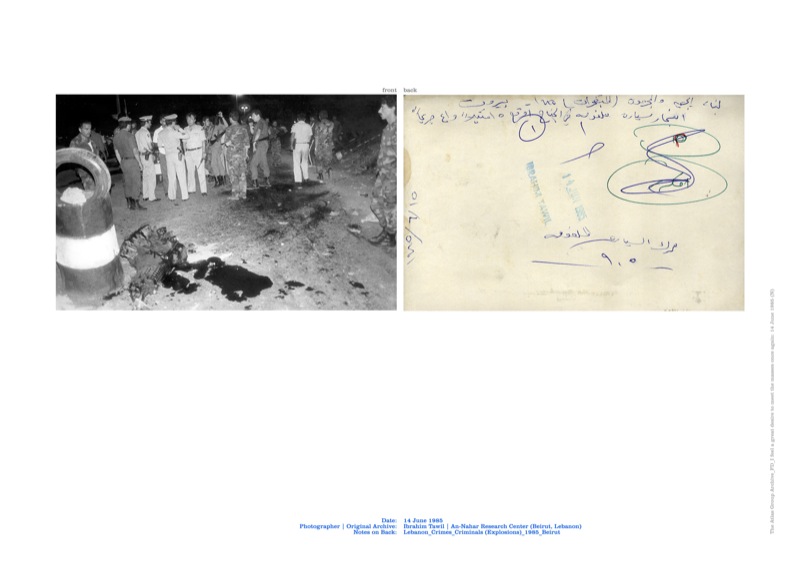
The Atlas Group archive is a collective artwork over a period between 1989-2004 with particular emphasis on the Lebanese wars. This group of archives is divided into 3 categories: A - authored files, FD - found files and AGP - Atlas Group Productions. A range of medium such as photographs, videos, and collages are used in the creation of this particular archive.
The exhibitions opens with an AGP (Atlas Group itself) project ‘My neck is thinner than a hair’.
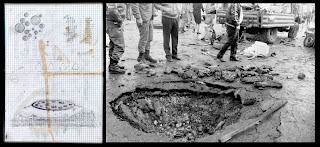
It focuses on car engines found after car bombings during the Lebanese wars from 1975 to 1998. The series of black and white photographs document the situation. The images, either in close-up or of empty landscapes often include gatherings of curious individuals. Some of the engines are still steaming, which attract even more attention amongst locals. The scenarios appear to be public events, especially with a marital presence. Moving from one photograph to another, the location looks rough and shabby, even dangerous.
Another AGP series includes the work of topographer Nahia Hassan. His pictures of fiery steam have been displayed on white paper, giving an impact on its own. The miniature patterns of steam are photographed in various stages, from warm yellow to radiant orange.
Before moving on, a video footage from group A files pauses the audience to watch a tape of an Arab hostage Bachar. His captivity compared to that of five Americans hostages, was the longest. During his time in the cell he received disgust and mixed feelings from fellow inmates that would turn him on. His cellmates, the five Americans all wrote a book about their hostage years in Lebanon which was published in five different versions. Bachar shared his story with The Atlas Group project.
A collection of group A introduces a series of notebooks by a fictional character a man the name of, Dr. Fakhouri. His first collage type project called ‘Already been in a lake of fire’ draws attention to cutout photographs of cars. Models ranging from U.S Volvo to Chevrolet in shaded blue and plum colour. The details, in Arabic include the relevant information as to how many people each car bomb killed or injured. It reflects a study based on car bombings.
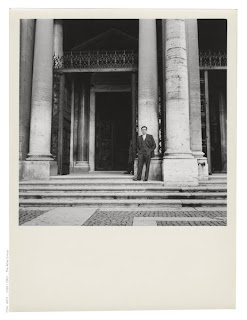
The following project ‘Civilizationally we do not only dig holes to bury ourselves’ is based on a series of black and white self-portraits documenting Dr. Fakhouri’s journeys to Paris, Rome and Lebanon. Mostly he has been photographed alone in front of tourist sites. His sense of belonging is expressed when he posed with strangers.
Another series titled ‘Missing Lebanese Wars’ draws attention to Dr. Fakhouri’s obsession with gambling at horse racing. A description of equine records and several other notes have been included on a collage type artwork.
A series of large photographs of air and sea assault over West Beirut cover a whole wall. The photos illustrate the bombings and the soldiers on a break. The series from type A file is titled “We decided to let them say ‘we are convinced’ twice”. At the time Wally Raad, a young teenager was trying to capture the true action. The sensation captured on film is incredible, inflamed steam, curiosity in people eyes, and relaxing soldiers.
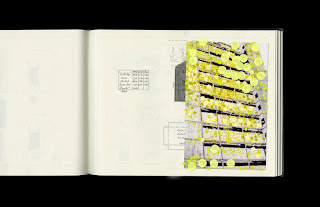
One of the most vivid projects in type A collection is ‘Let’s be honest the weather helped.’ Like many others at the time in Beirut Wally Raad also collected bullets and shrapnel. In photographs of bombed, even demolished houses, all the bullet holes have been pasted-up with correctly measured dots. Raad marked different ammunition with a distinctive colour code. The photographs portray an empty city, with no-one in the streets. The only colour in the abandoned place got is from the pasted-up bullet holes in yellow, green, orange and purple.
The remarkable collection in catalog FD titled ‘Secrets in the open sea’ contains a series of photographs in shades of blue that were found buried under the rubble during 1992. Currently below the blue shades are depicted small pictures of people who died. The recovered photographs were once prints of individuals before a demolition of Beirut’s commercial district. The cuts into plain paper subtly expose the human figures, the dead, beneath it.
In between the dramatic war scenes and recovery time is a collection of abstract Arabic art. A series of details from artists such as Neon Saadi, Johnny Tahan, Zohrab and an architect in Lebanon is displayed in collage form. Each collage includes artist sketches, reviews, accounts and even price lists. Contemporary Arabic art emerged from various forms and colours, while the wars affected also layers and lines.
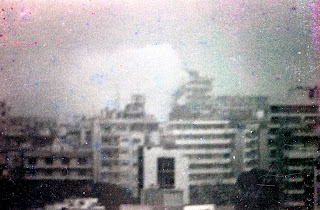
Recovery time includes panoramas taken of Beirut while it was re-built during 1996-1997. The photographs stitched and overlapping expose beautiful shades of sky, from morning to sunset. In the series are shots of contemporary Beirut buildings, still shabby, and portraits of people.
‘Sweet talk’ is in the collection of AGP Group photographs taken in the late 1980s. In the midst of the Lebanese wars, Wally Raad committed himself to capturing Beirut residents, street scenes, and objects in order to document the everyday life.

Photographs from
http://www.theatlasgroup.org/